

People'sDaily:With the installation of the dome on the containment building, all major civil engineering works have been completed at Unit 5 of the Hongyanhe nuclear power plant developedby China's State Power Investment Corp, located Northeast China's Liaoning province. [File Photo]
Chinese companies are craving access to the colossal untapped potential of the nuclear power industry in Belt and Road countries, which could yield a market of up to 4 trillionRMB ($580 billion), said the chairman of one of the country’s largest nuclear powerdevelopers.
“About 72 countries have been or are planning to develop nuclear power, among which 41 are along the Belt and Road route, and most of them are still in the earliest stages ofnuclear power development. We estimate that if their nuclear energy were raised to reachdevelopment levels comparable to those of the U.S. or Japan, it would spawn a marketworth 4 trillion RMB, ” remarked Wang Shoujun, chairman of China National NuclearCorp (CNNC).
The Belt and Road Initiative, proposed by Chinese President Xi Jinping in 2013, aims tobuild a trade and infrastructure network connecting Asia with Europe and Africa alongancient trade routes, in an unprecedented effort that will unite up to 65 countries.
China a powerful nuclear tech player
As domestic demand for electricity soars in China, and the country accelerates its shift torenewable energy, nuclear power will be one of the highest-priority projects. Chinacurrently operates 36 nuclear reactors, and is in the process of building 20 new ones, according to an official with the Ministry of Environmental Protection.
By the end of 2020, China aims to have 58 million kilowatts of nuclear power capacity inoperation and more than 30 million kilowatts under construction, ranking second in theworld for number of installed units.
When it comes to homegrown technologies, China is gathering steam to occupy a positionof leadership in the world. The Hualong One pressurized water reactor, manufactured byChina First Heavy Machinery, completed its hydraulic pressure tests on April 8. Thismilestone shows that China has mastered the independent design and manufacture ofthird-generation nuclear power facilities.
On Jan. 5, 2017, State Power Investment Corp (SPIC), one of China’s five largest powergenerators, released NuPAC platform, a digital instrumentation and control system fornuclear power plants, complete with independent intellectual property rights. Theplatform has obtained approval from the U.S. Nuclear Regulatory Commission, giving itaccess to American and European markets.
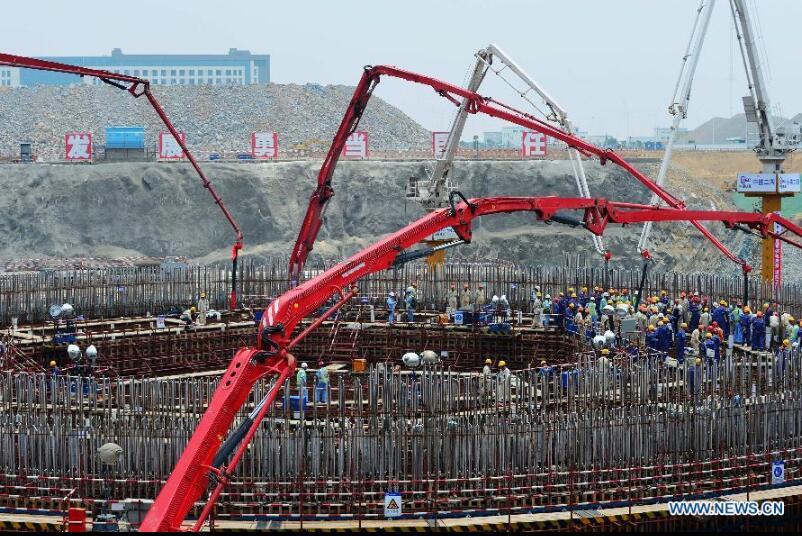
Photo taken on May 7, 2015 shows the construction site of a nuclear power project inFuqing, southeast China's Fujian Province. China on Thursday began construction on thepilot nuclear power project using Hualong One technology, a domestically-developedthird generation reactor design on Thursday.
Sailing abroad
With the third-generation Hualong One reactor as a star export, Chinese nucleartechnologies have established a presence in the U.K., Romania, Pakistan and beyond.
In March, China General Nuclear Power Corporation (CGN) inked a protocol with Kenyaon nuclear power training based on the Hualong One reactor, coming one step closer toactually exporting the Hualong One design to Kenya, and testing the waters on otherexports of technology and equipment overseas.
Citing indigenous technologies like Hualong One, the president of CGN Group announcedthat homegrown technologies “lay the foundation for China’s nuclear expansion overseas.”
According to CNNC Chairman Wang Shoujun, CNNC has successfully exported six nuclearpower units and eight reactors to at least seven countries, and has established links withmore than 40 countries for further cooperation spanning the full nuclear industrial chain.
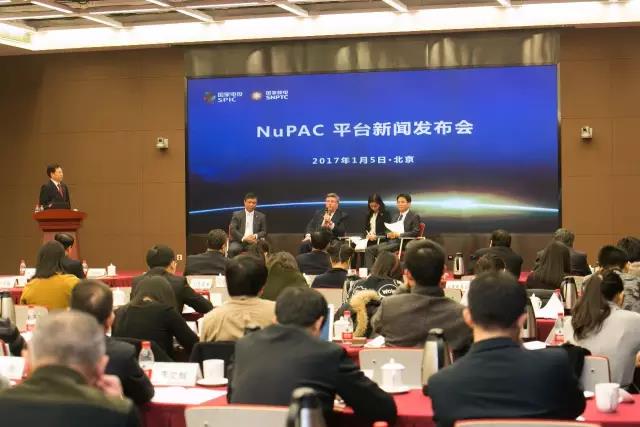
SPIC releases NuPAC Platform, a nuclear reactor protection system with independentintellectual property rights. [File Photo]
Nuclear, radiation safety measures “reliable”
According to sources from the National Nuclear Safety Administration (NNSA), fromAugust to September 2016, the International Atomic Energy Agency conducted acomprehensive nuclear and radiation safety evaluation. Their assessment found thatnuclear and radiation safety in China is in line with international standards, andregulatory work is effective and reliable.
An unidentified NNSA official noted that, in the past 30 years, the Chinese nuclearindustry has maintained a record of safe operations, with no incidents exceeding Level 2 or higher on the 7-level International Nuclear and Radiological Event Scale. No radiationwas deemed detrimental to the environment.
However, the official also stressed that a shortage of storage space for used fuel and thedisposal of radioactive waste is a major issue affecting the development of China's nuclearpower.
In March, China's State Council approved a plan for nuclear power safety and radioactivepollution control. According to the plan, China will build five sites for the disposal of solidwaste with a low or intermediate level of radioactivity. Underground laboratories will becalled upon to dispose of highly radioactive waste.
By 2025, China plans to have fully modernized its supervisory system for nuclear safetyand radioactive pollution control. The safety of the country's nuclear facilities will bemarkedly enhanced by 2020, with a lower rate of occurrence of radiation accidents andbetter emergency response and safety supervision, according to the plan.